
Bamboo torture is among the most discussed tortures in popular culture. However, when searching for material evidence or firsthand accounts, the record turns out to be almost empty. Between the actual botanical capacity of bamboo and the construction of an orientalist narrative, what remains concrete to examine?
Bamboo and tissue penetration: what botany really allows

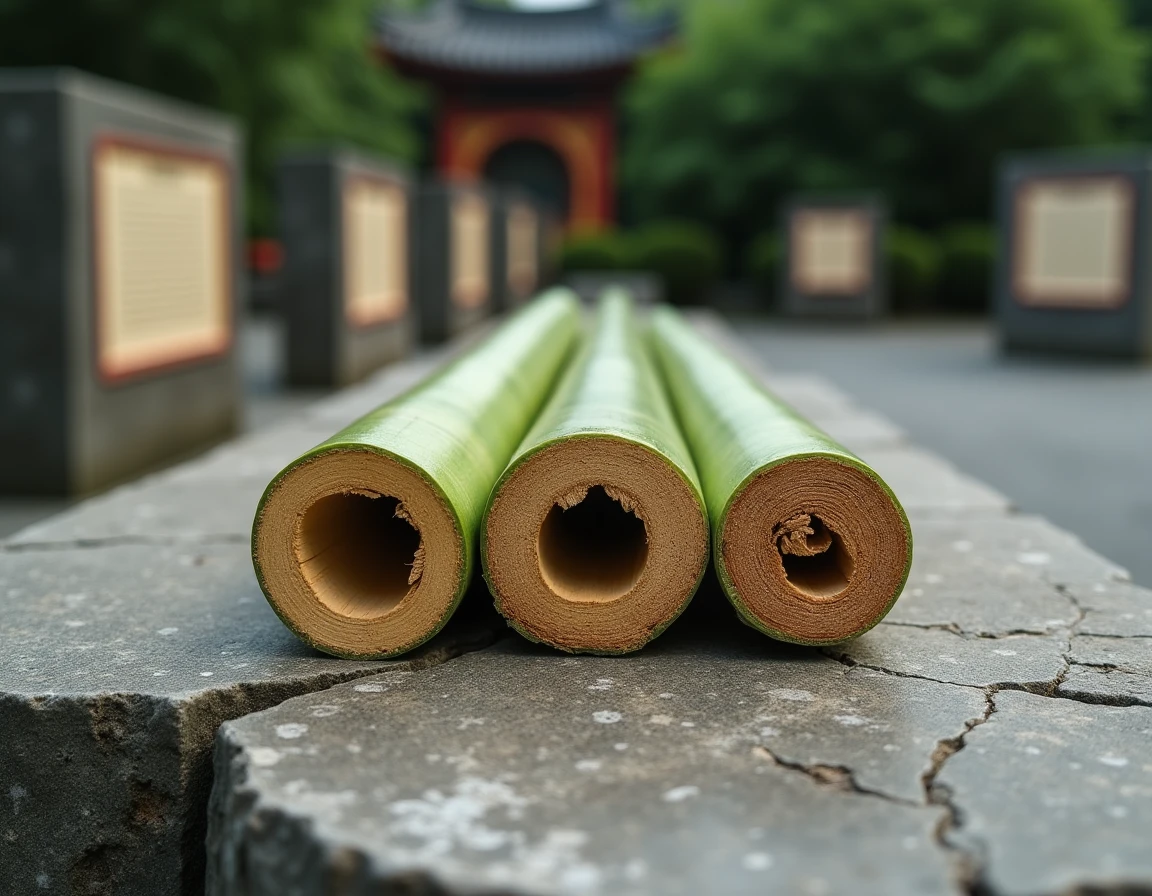
The principle often described relies on the growth rate of certain species of bamboo. According to the Wikipedia article on bamboo torture, some species can grow at a rate of 4 cm per hour. This botanical data forms the basis of the legend: a shoot directed upwards would exert continuous pressure on a body immobilized above it.
The classic description of the torture follows a precise pattern. One strips and sharpens the end of a young shoot, immobilizes the victim horizontally above, and the plant growth does the rest over several hours. The idea that Chinese bamboo torture would have been practiced in several East and South Asian countries (China, India, Japan) circulates widely in popular narratives.
The penetrating force of a bamboo shoot through soft materials has been the subject of modern experiments featured in television shows. These tests have shown that a shoot can penetrate certain organic materials. However, none of these experiments replicate the actual conditions of torture on a human being, leaving a considerable gap between botanical demonstration and the alleged historical reality.
Historical evidence of bamboo torture: an empty file
The most striking point of this file is the almost total absence of reliable evidence. The Wikipedia encyclopedia states unequivocally: no reliable evidence of the use of this torture has been found.
The circulating accounts rely on indirect testimonies, often second or third hand. There are mentions attributed to prisoners of war, particularly during World War II, but critical analyses of these sources point out inconsistencies and the absence of medical or archaeological corroboration.
| Criterion | Bamboo Torture | Lingchi (death by a thousand cuts) |
|---|---|---|
| Material evidence (bones, instruments) | None found | Photographs, multiple testimonies, judicial archives |
| First-hand sources | Absent or unverified | Chinese administrative documents |
| Archaeological confirmation | None | Partially attested |
| Main attribution period | Vague (Antiquity to World War II) | Ming and Qing dynasties, documented until 1905 |
| Dominant register of narratives | Legend, popular culture | Historiography, criminal law |
This table highlights a clear contrast. Other tortures attributed to China, such as lingchi, have verifiable documentary traces. Bamboo torture, on the other hand, falls into a more legendary than documentary register.
Orientalist construction of the Chinese torture: the role of Western narratives
The work of Jérôme Bourgon on lingchi and studies on the “cage torture” illuminate a broader mechanism. “Chinese tortures” have largely been reinvented or amplified by travelers, missionaries, journalists, and Western photographers.
The goal, whether conscious or not, was to provide proof of “Oriental barbarism” that justified by contrast the civilizational superiority claimed by colonial powers. Bamboo torture fits into this same constellation of narratives. It shares with other supposedly Asian tortures a common characteristic: the more spectacular the narrative, the weaker the sources.
- European missionaries in China during the 17th and 18th centuries produced descriptions of tortures that were often exaggerated, blending real observations with cultural projections.
- Accounts of prisoners of war in the 20th century frequently echoed pre-existing motifs in colonial literature, complicating their use as independent evidence.
- The iconography of “Chinese tortures” in 19th-century European illustrated press favored sensationalism over accuracy, creating a lasting but misleading imaginary.
This framework does not imply that all punitive practices in Asia are fictional. Lingchi did indeed exist. However, bamboo torture has not crossed the threshold of historical proof.
Why this narrative persists in popular culture
The longevity of this legend can be explained by several converging factors. The botanical data on the growth rate of bamboo is real and verifiable, giving the narrative an appearance of scientific plausibility. The described mechanism is simple to visualize and sufficiently horrifying to leave a mark in memory.
Popular science shows and online forums have regularly reignited the topic, often without distinguishing the physical capability of the plant from the documented existence of the torture. This confusion between “it’s physically possible” and “it’s historically attested” constitutes the main spring of the myth’s persistence.
Bamboo torture and source criticism: methodological lessons
This file offers a case study on how a narrative can acquire the status of historical fact without ever being verified. Second-hand accounts cite each other, creating a circularity that gives the illusion of an abundant corpus.
- The absence of archaeological traces (no bones showing marks compatible with this type of torture have been identified) weighs heavily in the evaluation.
- Testimonies from prisoners of war, even sincere, are subject to memory biases and the influence of pre-existing narratives.
- Modern botanical experiments demonstrate a capability of the plant, not a human practice.
A botanical fact does not constitute historical proof. The distinction between these two registers remains key to evaluating this type of narrative. Current research on documented tortures in Asia, supported by judicial archives and material traces, shows that documentary rigor allows for the separation of the verifiable from the legendary, without the need for sensationalism.